SAP Commerce Architect Series — Part 4
SAP Commerce Interceptors Explained: Lifecycle Hooks, Design Decisions, and Enterprise Pitfalls
Interceptors are among the most useful extension mechanisms in SAP Commerce—and among the easiest to misuse. They can protect data integrity across every save path, calculate technical values consistently, and enforce rules close to the model lifecycle. They can also hide expensive work inside modelService.save(), create recursive save behavior, and make production failures surprisingly difficult to diagnose.
The real architectural question is therefore not simply how do we create an interceptor? It is which responsibilities belong in the model lifecycle, and which should remain explicit in the service layer?
Introduction
In Parts 1 and 2 of this series, we designed ItemTypes, attributes, and enterprise data models. In Part 3, we explored how FlexibleSearch reads that data efficiently and safely. We now move to the write side of the platform: what happens around model creation, loading, saving, validation, and removal.
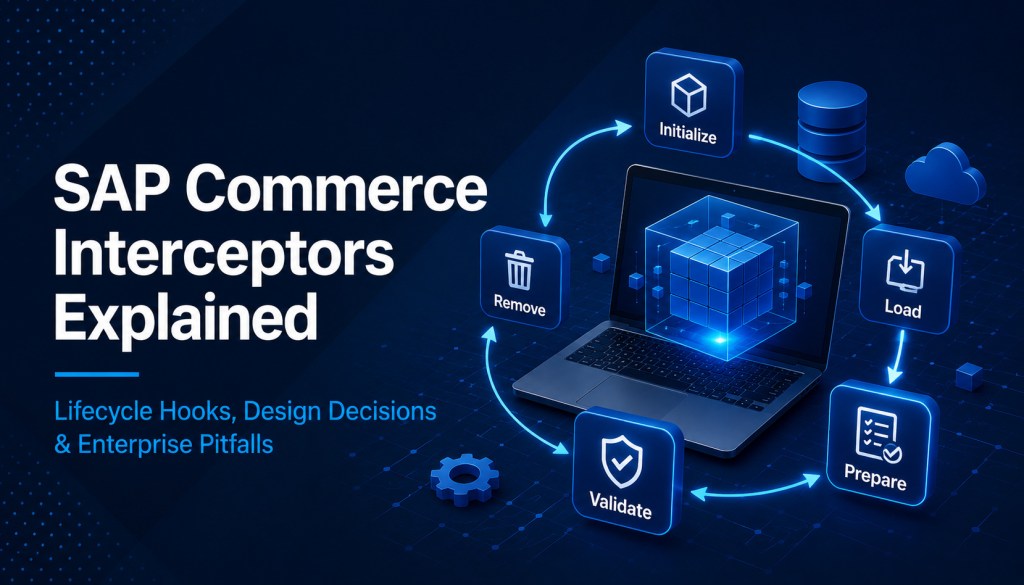
SAP Commerce interceptors participate in those lifecycle moments. They allow code to run when defaults are initialized, a model is loaded, data is prepared for persistence, a model is validated, or an item is about to be removed.
That description sounds simple, but it hides an important consequence: interceptor logic may run from storefront requests, OCC APIs, Backoffice operations, ImpEx imports, CronJobs, business processes, integrations, and administrative scripts. An interceptor is not attached to one screen or one service method. It becomes part of the persistence behavior of the mapped type and its subtypes.
Key Takeaway
An interceptor is a platform-wide model-lifecycle policy, not a convenient callback for one use case.
1. Why Do Interceptors Exist?
Enterprise data can enter SAP Commerce through many paths. A product may be changed through Backoffice, imported through ImpEx, updated by an integration, or modified by a scheduled job. If an essential data rule exists only in one facade or controller, another entry path can bypass it.
Interceptors provide a central enforcement point around model persistence. Used carefully, they help keep the stored data valid regardless of which application flow initiated the change.
Consider a custom BusinessDocument type with validFrom and validTo attributes. The rule that validTo cannot be earlier than validFrom is a model-level invariant. Allowing invalid dates into the database would make every downstream reader responsible for defending against corrupt state.
A validation interceptor is a reasonable place for that invariant because the rule should hold whenever the model is saved. Sending a confirmation email after the document is created, however, is a business workflow. Hiding that action inside an interceptor would make a database save unexpectedly trigger an external side effect.
Design Insight
Use interceptors to protect model state. Use explicit services, events, and business processes to coordinate business behavior.
2. The Five Main Interceptor Types
SAP Commerce provides five principal interceptor interfaces. Each represents a different lifecycle responsibility.
| Interceptor | Trigger | Appropriate responsibility | Primary risk |
|---|---|---|---|
InitDefaultsInterceptor | Default initialization for a new model | Lightweight technical defaults | Treating defaults as guaranteed persisted values |
LoadInterceptor | Model loading | Rare compatibility or technical adjustments | Read-path latency and hidden mutation |
PrepareInterceptor | Before validation and persistence | Deterministic normalization or derived fields | Hidden behavior and recursive changes |
ValidateInterceptor | After preparation, before persistence | Model invariants and data-integrity checks | Database calls and overly broad rules |
RemoveInterceptor | Before removal | Removal protection or tightly related cleanup preparation | Cascading deletes and heavy work |
The distinction between these types matters. A rule placed in the wrong lifecycle phase may appear to work in a basic test while behaving incorrectly during imports, batch saves, or inherited type processing.
3. InitDefaultsInterceptor: Helpful Defaults, Not Business Truth
InitDefaultsInterceptor initializes values when a new model is created through the model lifecycle. It is useful for lightweight defaults that make a newly created model easier to work with.
For example, a custom document may begin in a draft state:
public class BusinessDocumentInitDefaultsInterceptor implements InitDefaultsInterceptor<BusinessDocumentModel>{ @Override public void onInitDefaults( final BusinessDocumentModel document, final InterceptorContext context) { if (document.getStatus() == null) { document.setStatus(BusinessDocumentStatus.DRAFT); } }}
This default improves consistency, but architects should not confuse initialization with persistence. The model is still transient until it is saved, and later code may intentionally replace the default.
Defaults that depend on remote calls, current business campaigns, complex searches, or user-specific orchestration do not belong here. Those decisions should be made explicitly by an application service that has the required business context.
Common Mistake
Using an initialization interceptor as a hidden factory service. If model creation requires several dependencies and business decisions, introduce a dedicated creation service or factory instead.
4. PrepareInterceptor: Normalize Before You Persist
The PrepareInterceptor runs before validation and before the model is persisted. It is designed for deterministic preparation of the state that will be saved.
Common uses include normalizing a technical identifier, deriving a stored search value, or setting a calculated attribute from values already available on the model. The operation should be fast, repeatable, and safe if executed more than once.
public class BusinessDocumentPrepareInterceptor implements PrepareInterceptor<BusinessDocumentModel>{ @Override public void onPrepare( final BusinessDocumentModel document, final InterceptorContext context) throws InterceptorException { if (context.isNew(document) || context.isModified(document, BusinessDocumentModel.EXTERNALCODE)) { final String externalCode = document.getExternalCode(); if (externalCode != null) { document.setNormalizedExternalCode( externalCode.trim().toUpperCase(Locale.ROOT)); } } }}
The dirty-attribute check is important. Without it, the interceptor recalculates the derived value on every save, even when the relevant source attribute did not change. That may be inexpensive in a small example but costly when the interceptor performs more complex work across large import batches.
Preparation must also be idempotent. If trimming and uppercasing the same code twice produces the same result, repeated execution is safe. If the interceptor appends a suffix every time it runs, the model changes again on each save and the design is unstable.
Best Practice
A prepare interceptor should behave like a deterministic function: the same relevant model state should produce the same prepared result.
5. ValidateInterceptor: Protect Model Invariants
The ValidateInterceptor runs after all required prepare interceptors and before persistence. It should reject model state that must never be stored.
public class BusinessDocumentValidateInterceptor implements ValidateInterceptor<BusinessDocumentModel>{ @Override public void onValidate( final BusinessDocumentModel document, final InterceptorContext context) throws InterceptorException { final Date validFrom = document.getValidFrom(); final Date validTo = document.getValidTo(); if (validFrom != null && validTo != null && validTo.before(validFrom)) { throw new InterceptorException( "validTo must be equal to or later than validFrom"); } }}
This is an appropriate validation because it concerns the internal consistency of one model and should apply to every persistence path. The rule does not require a remote system or a long-running operation.
Not every business rejection belongs in a validation interceptor. A customer-specific purchasing limit, a temporary promotion rule, or an external credit decision normally needs request context, explicit error handling, and possibly remote communication. Those rules are better placed in an application service or validation strategy invoked by the use case.
Model invariant or use-case rule?
Ask these questions before choosing a validation interceptor:
- Must this rule remain true regardless of who saves the model?
- Can the rule be evaluated quickly and deterministically?
- Is all required information already available locally?
- Should every save path fail if the rule is violated?
- Can the caller receive a meaningful error without knowing a hidden workflow?
If the answer to several questions is no, the rule probably belongs outside the interceptor layer.
Enterprise Insight
Validation close to persistence is powerful because it is difficult to bypass. That same power makes an overly broad interceptor a platform-wide operational risk.
6. LoadInterceptor: The Most Expensive Place to Be Casual
LoadInterceptor runs when a model is loaded from persistence. Because reads happen far more frequently than writes in many commerce systems, even a small amount of work can create significant cumulative cost.
A load interceptor should therefore be rare. It must not perform remote calls, save the loaded model, or execute additional queries casually. Doing so can create query amplification: loading a result set of hundreds of models may trigger hundreds of extra operations.
Suppose a search returns 500 products. A load interceptor that performs one additional lookup per product can turn one expected query path into hundreds of database interactions. The original service code will not reveal that behavior, making the latency difficult to understand from the call site.
Use a converter, populator, read service, cache, or explicit enrichment step when the requirement concerns presentation or response construction. Reserve load interceptors for narrowly justified lifecycle concerns where the behavior truly must occur whenever that type is loaded.
Common Mistake
Using a load interceptor to enrich DTO-facing data. Model loading and API response composition are different responsibilities.
7. RemoveInterceptor: Guard Deletion Without Building a Hidden Workflow
The RemoveInterceptor runs before a model is removed. It can prevent removal when a model is still referenced by an important business object or participate in tightly controlled cleanup behavior.
public class BusinessDocumentRemoveInterceptor implements RemoveInterceptor<BusinessDocumentModel>{ @Override public void onRemove( final BusinessDocumentModel document, final InterceptorContext context) throws InterceptorException { if (BusinessDocumentStatus.APPROVED.equals(document.getStatus())) { throw new InterceptorException( "Approved business documents cannot be removed"); } }}
This example protects an invariant: an approved record must remain available. In a real solution, retention and deletion rules should also align with privacy, audit, and data-governance requirements.
Avoid turning a remove interceptor into a large cascade engine. Removing thousands of related records, calling external systems, or publishing critical notifications inside the removal lifecycle creates long transactions and difficult recovery behavior. Large cleanup operations deserve an explicit service or scheduled process with observable progress and retry handling.
8. What Actually Happens During a Save?
For a normal save operation, it is useful to think in phases rather than as a single database call:
Application changes model ↓modelService.save(...) ↓Prepare interceptors ↓Validate interceptors ↓Persistence ↓Transaction completes or rolls back
Prepare interceptors may modify the model before validation. Validate interceptors therefore see the prepared state, not necessarily the exact state originally passed by the caller. If validation fails, persistence does not complete successfully.
Models registered through the InterceptorContext may also become part of the persistence operation. This capability is useful for closely related model changes, but it increases the size and complexity of the save graph. Registering additional elements should be an intentional design decision, not a substitute for a clear transactional service.
The context also provides information such as whether a model is new, whether an attribute was modified, and which elements are already associated with an operation. These checks help prevent unnecessary work and repeated registration.
Key Takeaway
modelService.save()is not merely a SQL write. It is a lifecycle pipeline whose cost and behavior include every mapped interceptor.
9. Registration and Type Inheritance
An interceptor implementation becomes active only after it is mapped to a type. A typical Spring configuration uses an InterceptorMapping:
<bean id="businessDocumentPrepareInterceptor" class="com.example.core.interceptor.BusinessDocumentPrepareInterceptor"/><bean id="businessDocumentPrepareInterceptorMapping" class="de.hybris.platform.servicelayer.interceptor.impl.InterceptorMapping"> <property name="interceptor" ref="businessDocumentPrepareInterceptor"/> <property name="typeCode" value="BusinessDocument"/></bean>
The mapping applies to the configured type and its subtypes. This inheritance behavior is easy to overlook. Mapping broad logic to a parent type can cause it to execute for far more models than the original developer intended.
Multiple interceptors may also be registered for the same lifecycle phase and type hierarchy. If one interceptor depends on another interceptor’s output, that dependency must be made explicit through the supported ordering configuration or, preferably, removed by redesigning the responsibility. A fragile chain of hidden mutations is difficult to maintain.
Before introducing a mapping, inspect the interceptors already registered for the target type and its ancestors. Platform and extension-provided interceptors may already enforce related behavior.
Best Practice
Map an interceptor to the narrowest type that genuinely owns the rule.
10. Why Calling save() Inside an Interceptor Is Dangerous
One of the most common interceptor mistakes is calling modelService.save() from inside a prepare or validate interceptor. The developer often wants to persist a related model immediately, but the call can re-enter the interceptor pipeline.
That creates several possible problems:
- Recursive interceptor execution
- Duplicate preparation or validation
- Unexpected save ordering
- Larger and less predictable transactions
- Stack overflow or cyclic model processing
- Failures that appear far away from the original business operation
When another model genuinely belongs to the same persistence operation, evaluate whether it can be registered with the InterceptorContext. When the operation represents an explicit business transaction, move the orchestration to a service that changes the models and saves them deliberately.
public void updateDocumentAndAudit( final BusinessDocumentModel document, final String note){ document.setLastNote(note); final DocumentAuditModel audit = modelService.create(DocumentAuditModel.class); audit.setDocument(document); audit.setMessage(note); modelService.saveAll(document, audit);}
This service makes the transaction visible to callers, tests, and maintainers. The interceptor can remain focused on invariant preparation or validation.
11. Avoid External Calls and Side Effects
An interceptor executes inside a persistence lifecycle that callers generally expect to be local and transactional. Calling an ERP, payment provider, search service, or another remote API from that lifecycle introduces unpredictable latency and failure modes.
If the remote call succeeds but the database transaction later rolls back, the external side effect may already be permanent. If the remote call times out, the caller may not know whether the external system completed the operation. Retrying the original save can then duplicate the side effect.
The safer pattern is to persist the required local state, complete the transaction, and initiate the external workflow through an explicit and observable mechanism. Depending on the requirement, that mechanism may be a business process, an event-driven handler, an outbound integration process, or a durable job.
Interceptors should also avoid sending email, publishing non-transactional messages, writing files, or performing expensive indexing operations directly. These are business and integration effects, not model-lifecycle invariants.
Architecture Decision
If a failure requires retry policy, compensation, monitoring, or operational ownership, the work belongs in an explicit workflow—not inside an interceptor.
12. Performance: The Cost Multiplier Effect
Interceptor cost is multiplied by the number of affected models. A 10-millisecond query may appear harmless during a single Backoffice save, but an ImpEx importing 100,000 rows can turn that query into substantial database pressure.
Evaluate interceptor performance across all major write paths:
- Single storefront or OCC request
- Backoffice save
- Large ImpEx import
modelService.saveAll(...)- CronJob batch processing
- Integration-driven updates
- Subtype saves inherited from a parent mapping
Prefer local attribute checks over database lookups. Use context.isNew(...) and context.isModified(...) to skip work when relevant state has not changed. If uniqueness or referential integrity can be expressed reliably through the type system and database schema, do not reproduce it with a query on every save.
When a query is unavoidable, confirm that its search attributes are indexed and that the rule truly requires persistence-time enforcement. Measure the complete batch behavior rather than timing one interactive save.
Enterprise Insight
An interceptor is executed where the data volume is. Performance testing must use production-like batch sizes, not only developer-scale examples.
13. Error Messages Are Part of the Design
Throwing InterceptorException stops the lifecycle operation, but the message may surface in Backoffice, import logs, API error handling, or operational monitoring. A vague message such as “validation failed” forces users and support teams to reconstruct the problem.
A useful validation message identifies the invalid condition and, when safe, the affected attribute. It should avoid confidential data, internal implementation details, stack-trace language, and instructions that only one entry channel understands.
Good message:
validTo must be equal to or later than validFrom
Weak message:
Document validation error
For public APIs, translate internal exceptions into a stable error contract at the API boundary. Do not expose raw interceptor exceptions or Java class details directly to external consumers.
14. Testing Interceptors Properly
Interceptor tests should cover lifecycle behavior, not only direct method invocation. A unit test of onValidate() is valuable for rule logic, but an integration test through modelService.save() confirms mapping, ordering, preparation, validation, and rollback behavior.
Unit-test responsibilities
- New-model and existing-model paths
- Relevant attribute changed and unchanged
- Null and boundary values
- Idempotent preparation
- Expected
InterceptorExceptionmessages - No unnecessary collaborator invocation
Integration-test responsibilities
- Mapping activates for the intended type
- Mapping behavior for subtypes is intentional
- Prepare executes before validation
- Invalid data is not persisted
- Related registered models behave correctly
- Batch saves do not create recursive execution
- Removal rules work through
modelService.remove()
@Testpublic void shouldRejectEndDateBeforeStartDate(){ final BusinessDocumentModel document = modelService.create(BusinessDocumentModel.class); document.setCode("DOC-1001"); document.setValidFrom(date(2026, Calendar.SEPTEMBER, 10)); document.setValidTo(date(2026, Calendar.SEPTEMBER, 9)); assertThrows(ModelSavingException.class, () -> modelService.save(document));}
The exact outer exception observed by callers can depend on how the interceptor failure is wrapped by the model service. Test the public behavior your application relies on while keeping focused unit tests for the interceptor’s direct exception.
15. Interceptor or Service Layer? A Decision Matrix
| Requirement | Interceptor | Service or workflow | Why |
|---|---|---|---|
| Normalize a code before every save | Yes | Sometimes | Deterministic model preparation |
| Ensure an end date is not before a start date | Yes | Optional pre-check | Universal model invariant |
| Call an external pricing service | No | Yes | Remote latency and failure handling |
| Send an email after approval | No | Yes | Side effect and retry requirements |
| Enforce a use-case-specific purchasing rule | Usually no | Yes | Depends on actor and business context |
| Prevent deletion of a protected record | Yes | Optional orchestration | Universal removal invariant |
| Create a large graph of related records | No | Yes | Explicit transaction and observability |
| Populate a DTO display label | No | Converter/populator | Presentation responsibility |
| Start a long-running process | No | Business process/event | Durable lifecycle and monitoring |
The service layer and interceptor layer may cooperate. A service can validate early to give the user an immediate, use-case-specific response, while an interceptor provides a final persistence boundary for a true invariant. The duplication should be intentional and should share reusable validation logic where appropriate.
16. A Practical Enterprise Design Pattern
Suppose an integration creates and updates business documents. The model requires normalized external codes, consistent effective dates, and an approval workflow.
A clean design separates responsibilities:
- The application service authorizes the operation and coordinates the use case.
- A prepare interceptor normalizes the external code when it changes.
- A validate interceptor protects date consistency on every save.
- The service persists the valid model.
- After the transaction, an explicit event or business process handles approval notifications and external integration.
This structure keeps the model safe without hiding the entire workflow inside persistence. It also creates clear testing boundaries: interceptor tests cover invariants, service tests cover orchestration, and process tests cover asynchronous behavior.
Design Insight
The best interceptor design is often small because the surrounding architecture gives every responsibility a visible home.
17. Production Troubleshooting Checklist
When a save unexpectedly fails or becomes slow, inspect interceptor behavior systematically:
- Identify the concrete model type and all relevant parent types.
- List the prepare, validate, remove, load, and initialization mappings for that hierarchy.
- Check whether the failure occurs only for new models, modified models, or specific attributes.
- Review database queries, remote calls, and model saves inside each interceptor.
- Look for additional models registered through the context.
- Reproduce with the same entry path: Backoffice, ImpEx, OCC, CronJob, or integration.
- Compare single-save behavior with batch behavior.
- Confirm transaction rollback and error wrapping.
- Measure execution time and query count rather than relying only on log timestamps.
Adding temporary diagnostic logging can help, but do not log sensitive model data. Include the interceptor name, model type, safe identifier, lifecycle phase, and elapsed time where appropriate.
18. Architect Review Checklist
Before approving a new interceptor, ask:
- Is this rule genuinely tied to the model lifecycle?
- Must it apply to every save or removal path?
- Is the mapped type narrow enough?
- Does the behavior unintentionally affect subtypes?
- Is the logic deterministic and idempotent?
- Does it avoid remote calls and non-transactional side effects?
- Does it avoid calling
modelService.save()recursively? - Does it skip work when relevant attributes are unchanged?
- Is database access minimal, indexed, and tested at batch scale?
- Are error messages meaningful and safe?
- Are unit and lifecycle integration tests present?
- Would an explicit service, event, or process make the behavior clearer?
If the design cannot answer these questions confidently, the interceptor is probably carrying too much responsibility.
Conclusion
SAP Commerce interceptors are not merely technical hooks. They are part of the persistence contract for the types to which they are mapped. That makes them excellent for lightweight defaults, deterministic preparation, universal validation, and carefully constrained removal protection.
Their reach is also what makes them dangerous. Hidden queries, remote calls, recursive saves, broad parent-type mappings, and business workflows inside interceptors can affect every channel and batch process that touches the model.
The architectural principle is straightforward: keep interceptors small, local, deterministic, and focused on model integrity. Keep orchestration, side effects, retries, and long-running behavior visible in services and workflows.
Key Takeaway
Use interceptors to make invalid model state difficult to persist—not to make business behavior invisible.
Frequently Asked Questions
In what order do prepare and validate interceptors run?
Prepare interceptors run before validate interceptors during the save lifecycle. Validation therefore evaluates the prepared model state.
Does an interceptor mapped to a parent type affect its subtypes?
Yes. Interceptor mappings apply to the configured type and its subtypes, so broad mappings require careful review.
Should I query the database from a validate interceptor?
Only when the invariant genuinely requires persisted data and the lookup is efficient. Prefer model-local checks, schema constraints, indexed searches, and change detection whenever possible.
Can I call modelService.save() inside a prepare interceptor?
It is generally unsafe because it can re-enter the interceptor pipeline and create recursive or unpredictable behavior. Use the interceptor context for closely related persistence registration or move orchestration into an explicit service.
Should an interceptor call an external API?
No. External calls introduce latency, uncertain outcomes, retry requirements, and transaction inconsistencies. Use an explicit integration workflow or asynchronous process.
When should I use a load interceptor?
Use one only for a narrowly justified lifecycle concern that must occur whenever the model is loaded. Do not use it for DTO enrichment, remote access, or routine database lookups.
Should validation exist in both the service layer and an interceptor?
It can. A service may validate early for a better use-case response, while an interceptor protects a universal persistence invariant. Share validation logic when possible and keep the responsibilities explicit.
What Comes Next?
In Part 5, we will explore SAP Commerce Service Layer Architecture—how facades, services, strategies, DAOs, converters, populators, and model persistence should collaborate without blurring responsibilities.


Leave a Reply